
If you have ever spotted root-rot mushrooms appearing around an old stump in your yard, you may already know it isn’t a good sign. In this guide, Earthworks Tree Services explains how stump grinding can reduce a major source of decaying wood that supports fungal growth, and when additional treatment may be necessary. The company offers stump grinding in Asheville, NC, and the surrounding areas.
Why Tree Stumps Attract Fungus in the First Place
A tree stump left in the ground may not just sit there decomposing. Under the right conditions, it may actively invite fungal growth because of what is still happening beneath the surface. Moisture collects inside the wood, and the root system can stay partially alive for a while, so the whole structure can become an ideal place for fungal spores to settle.
Fungi feed on decaying wood, and a fresh stump is essentially a buffet. Left alone long enough, the stump can develop fungal infections, and some species can spread through the root network and into the surrounding soil. Nearby shrubs or grass could be affected as well.
What Fungal Growth Around a Stump Might Look Like
Figuring out how stump grinding prevents fungal growth comes down to science. Removing most of the food source can curb fungal growth before it has a chance to spread further. Still, mushrooms are just the visible part, as the real damage often happens underground or inside the wood itself.
If fungal growth is a problem, you might notice the following common warning signs around the stump:
- Soft, crumbly wood: A stump that once felt solid but now gives way easily when pressed or kicked.
- Odd clusters: Fungal fruiting bodies that appear suddenly, especially after rain.
Struggling grass or plants near the stump may also indicate poor soil conditions from the decay below, although many other issues can cause these symptoms.
If you’ve also noticed root-rot mushroom growth on trees around the yard, that is worth taking seriously. While some species are harmless decomposers, other types of fungi can move from a decaying stump into the root system of a nearby healthy tree.
How Stump Grinding Helps Prevent Fungal Growth
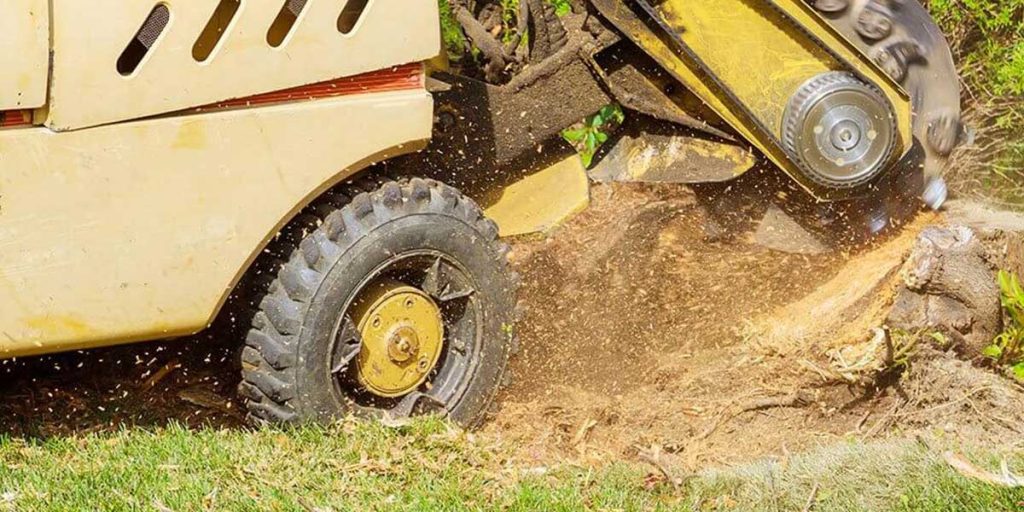
Grinding removes the stump well below the soil line, eliminating much of the visible decaying wood fungi depend on to survive.
Here is what grinding typically accomplishes:
- Reducing the available decaying wood: Grinding removes much of the stump that fungi can feed on, though infected roots may remain underground and require further evaluation or removal.
- Minimizing trapped moisture spots: Grinding breaks the wood into smaller pieces that dry out faster than a solid mass.
- Reducing mushroom regrowth: Without as much wood to feed on, the mushrooms produced by root-rot fungi may be less likely to return.
Once the grinding is finished, you’re left with a mix of soil and wood chips. That debris breaks down naturally and far more quickly than an intact stump would on its own.
Does Stump Grinding Fix Every Fungal Problem?
Grinding isn’t a total cure-all, and it’s worth understanding its limits. This service won’t eliminate every fungal spore in your yard, since those exist naturally outdoors. What grinding does accomplish, however, is removing the largest, most accessible source of decaying wood from the yard.
If a nearby tree already shows signs of infection, like unusual cavities, dead branches, or mushrooms, that situation calls for a closer look beyond the stump itself. It is best to call an arborist sooner rather than later.
Trust Earthworks Tree Services With Your Stump-Grinding Needs in and Around Asheville
There is a straightforward explanation for how stump grinding prevents fungal growth: Removing much of the decaying wood reduces a major food source for fungi. Once that stump is gone, your yard may have a real chance to recover and stay healthy. You might even reclaim that spot for a project that you’ve had in mind for a while.
Our team handles these services throughout the area and can advise homeowners on what to do after stump grinding to help the site recover properly. As certified arborists, we don’t just grind stumps; we bring the same plant health care expertise to hazardous tree evaluations and plant preservation across the board.
Now that you know how stump grinding can help prevent fungal growth, don’t wait for the problem to take hold. Call Earthworks Tree Services today at (828) 774-1984 to schedule stump grinding in Asheville, NC, and let our ISA-certified arborists take care of your yard.