
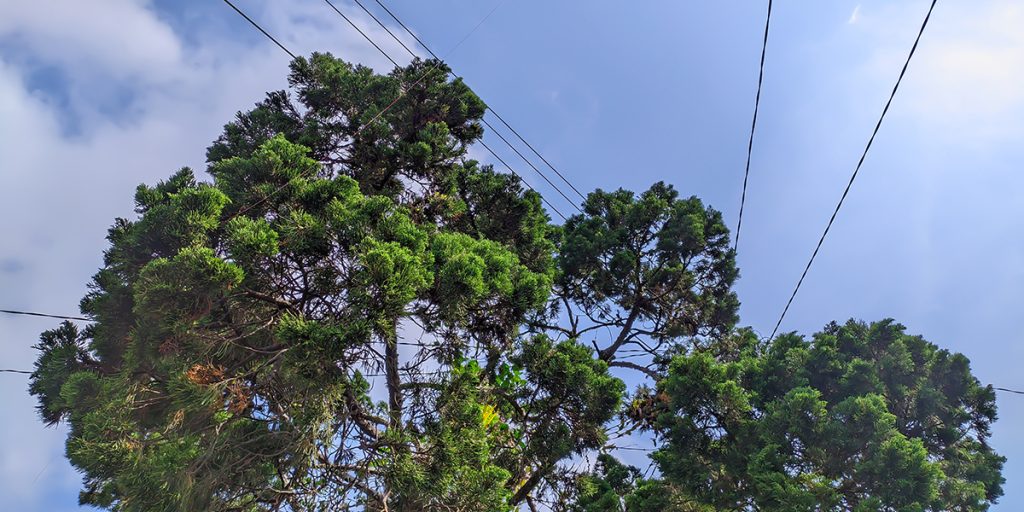
A branch hangs near the overhead power line crossing your yard. With a storm forecast for later in the week, you’re concerned about an outage or damage to your property. You’re unsure whether the utility company handles this situation or you need to schedule a tree service.
In this guide, Earthworks Tree Services explains who is responsible for trees growing around power lines. You’ll also learn when trimming or removal costs fall to the homeowner.
When Does the Utility Assume Responsibility for Tree Trimming?
For distribution and transmission lines, the utility usually handles tree trimming to maintain safe clearance. This work helps prevent outages and electrical hazards.
For trees growing around power lines, the work may involve cutting back branches or removing limbs that could fall onto the wires. Utility company tree maintenance prioritizes reliable electrical service, so the necessary cuts may leave the canopy uneven.
Understanding Property Owner Responsibilities
Property owners may need to arrange clearance around the service connection when their provider excludes it from routine maintenance. Contact the utility before hiring anyone to confirm the necessary electrical precautions.
Ask whether the contractor needs a temporary disconnection before they begin. Confirm that the crew has the appropriate line-clearance qualifications.
Who Pays for Trimming and Cleanup?
Routine trimming covered by the utility’s maintenance program generally does not result in a separate bill to the homeowner. Privately commissioned work outside that scope is usually your expense.
Request a written estimate that specifies whether hauling and disposal are included. If the recommendation is complete removal, also ask about stump grinding.
Cleanup policies can differ between scheduled maintenance and storm restoration. Emergency crews may restore electrical clearance but leave you responsible for debris disposal.
Why Does Work Near Wires Require Special Qualifications?
Power line clearance requirements address the space maintained between vegetation and electrical equipment. Separate approach limits determine how close workers may get, based on voltage and training. OSHA generally requires unqualified personnel to remain at least 10 feet from energized overhead wires, with greater separation above 50 kilovolts.
General arborist certification alone does not qualify someone to clear lines. The work requires specialized electrical hazard training and appropriate safety practices.
How To Report a Concern Before It Becomes an Emergency
Reporting trees near power lines early helps your utility assess whether routine clearance or an urgent response is needed. Be sure to:
- Provide your address and describe where the tree stands on the property.
- Explain what you can see from a safe distance, including damaged branches or growth approaching the wires.
- Attach photographs only if you can take them without moving closer to electrical equipment.
- Ask the provider to identify the line and confirm whether its crews will handle the work.
Keep a record of the report and any instructions provided for future reference.
What Should You Do if a Tree Falls on a Line?
A fallen branch touching a wire creates immediate electrical safety hazards, even without visible sparks. Take the following precautions:
- Stay back and treat every downed line as energized.
- Keep people and pets away from the affected area.
- Call 911 to report fallen wires or an immediate threat.
- Notify your electric utility through its emergency number.
Wait until the utility confirms the area is safe before arranging cleanup.
When Is Removal Safer Than Trimming?
Severe decay or a damaged trunk can make trees growing around power lines unstable. Cutting back branches may not reduce the risk of failure enough.
An arborist can assess whether trimming offers a safe, lasting solution. If the remaining structure cannot support its canopy, it may be time to remove your tree.
How Can Planting Choices Prevent Future Conflicts?
Choose a location based on mature height and canopy spread. A sapling that fits beneath overhead wires may eventually outgrow the available space.
Check your utility’s recommended species and planting distances before buying a replacement. Allow enough room for branches to develop without entering the electrical corridor, and keep access to poles unobstructed.
Plan Your Tree Care With Certified Arborists
Earthworks Tree Services provides certified arborist expertise in Asheville, focused on plant health and preservation. We assess structural weaknesses and decay before recommending care or removal.
Our crews employ rigorous rigging and climbing techniques to manage hazardous jobs. Where preservation is possible, we tailor trimming and supportive care to each tree’s condition.
Once the utility addresses any electrical hazards, we can help you determine the best time to trim your trees for long-term health. For a professional assessment of trees growing around power lines, call (828) 774-1984.